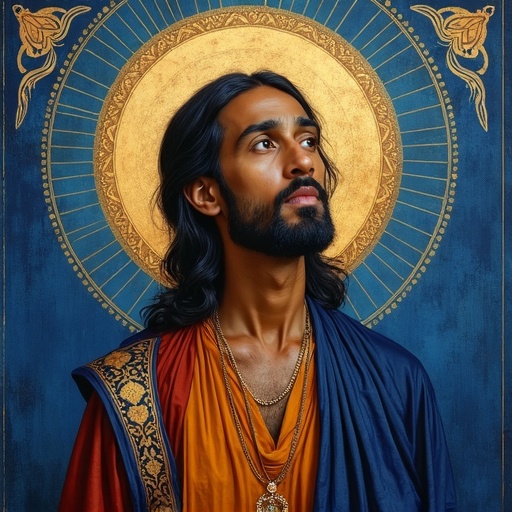
"Down on My Knees" is Jai Uttal's devotional song that uses poetic metaphor and sacred chanting to articulate spiritual longing for freedom. The piece explores the separation between soul and mind, the paradox of freedom through surrender, and the redemptive power of devotional practice. Through vivid imagery—a train carrying the soul and mind in different directions, swans in a lake of blood—Uttal creates a multidimensional meditation on the search for liberation, anchored in the mantra Om Namah Shivaya.
What does devotional surrender mean in spiritual practice?
In "Down on My Knees," Uttal performs a radical act of spiritual vulnerability—literally kneeling and begging for freedom. This posture is not weakness but a foundational practice in many contemplative traditions. By positioning the body and heart in surrender, the devotional practitioner acknowledges both the enormity of the search and the limitation of ego-driven effort. Uttal repeats the phrase "down on my knees crying for freedom" not as repetitive pleading but as a mantra that transforms complaint into prayer. The act of kneeling becomes itself a form of freedom—a liberation from the pretense of control or self-sufficiency.
How does the soul-mind division shape the song's central metaphor?
One of the most striking images in the song is the train that "left the station with two lights on behind"—the blue soul and the red mind traveling in the same direction but as distinct energies. This metaphor points to a central spiritual paradox: the mind and soul do not always align. The mind, conditioned by experience, memory, and fear, may pull toward one destination while the soul yearns for another. Uttal does not present this split as pathological but as something requiring acknowledgment and integration. The song's power lies in naming this division directly, making visible a condition many seekers experience but rarely voice. The soul and mind are on the same train, sharing the journey, yet the colors suggest they carry different frequencies of light.
What role does the Om Namah Shivaya mantra play?
The repeated chanting of "Om Namah Shivaya"—often translated as "I bow to Shiva" or "divine consciousness dwells within me"—provides the song with its anchor and resolution. This mantra appears at the end of each verse, not as an afterthought but as the culmination of the cry for freedom. In Hindu and yogic traditions, this mantra is understood to invoke transcendence and the dissolution of ego boundaries. By placing it after the most raw expressions of need and longing, Uttal suggests that the answer to the search for freedom is already present within the invocation itself. The mantra becomes the threshold: one does not merely ask for freedom while remaining unchanged, but rather calls upon the divine principle that is inseparable from one's own nature. The repetition shifts the emotional register from despair toward acceptance and union.
What spiritual meaning underlies the natural imagery?
Uttal employs surreal, even troubling imagery to convey the complexity of the human condition. A "lake of blood" on which "a pair of swans endlessly make love" creates cognitive dissonance—beauty and suffering coexist. This is not abstract darkness but a lived reality: suffering permeates the world (the lake of blood), yet love and creation (the swans) persist within it. The image suggests that freedom and fulfillment are not the absence of pain but rather the capacity to continue loving, creating, and connecting even while embedded in sorrow. The line "heaven's looking on" adds witness—the sacred sees this paradox and does not turn away. This mirrors a core teaching across many traditions: enlightenment or spiritual freedom does not mean escaping the world's pain but developing a different relationship to it.
How does the opening image set the spiritual tone?
"Time has reversed the acts of the play / The land talks in verse but I don't know what it's trying to say" suggests a condition of confusion and disorientation. The speaker is embedded in a performance—existence itself—but has lost the ability to interpret the script. The land, the earth itself, communicates in "verse," suggesting poetry and indirect meaning, yet comprehension eludes the narrator. This opening establishes the emotional and spiritual crisis from which the song emerges: a state of profound not-knowing paired with the urgency to understand. Rather than beginning with answers, Uttal begins with honest uncertainty. Only from this place of genuine confusion does the plea for freedom arise as something more than intellectual desire—it becomes existential necessity.
What is the relationship between crying and freedom in the song?
The song does not separate tears from liberation. To cry "for freedom" is not to weep about its absence but to actively summon it through emotion and voice. In devotional practice, tears are sacred—they dissolve the boundary between interior feeling and external expression. When Uttal sings "down on my knees crying for freedom," he is not passively lamenting but actively engaging in a practice. The crying becomes prayer; the prayer becomes mantra; the mantra becomes a direct channel to the divine principle invoked through Om Namah Shivaya. This represents a shift in understanding freedom itself: it is not something to acquire through effort alone but something to recognize and invoke through authentic emotional and spiritual presence.
Where to go from here
Listen to the full song and sit with the images Uttal presents—the train, the lake, the swans, the reversed time. Consider where in your own life you experience the separation between soul and mind, between what you know intellectually and what you yearn for spiritually. Explore the mantra Om Namah Shivaya through practice: chanting it aloud, silently, or in meditation, noticing how the invocation shifts your internal state. Research the iconography of Shiva in Hindu tradition to deepen your relationship with what the mantra calls upon. Finally, notice the moments in your own life when surrender and vulnerability have opened doors that effort and control could not. This is the territory the song invites you to explore.