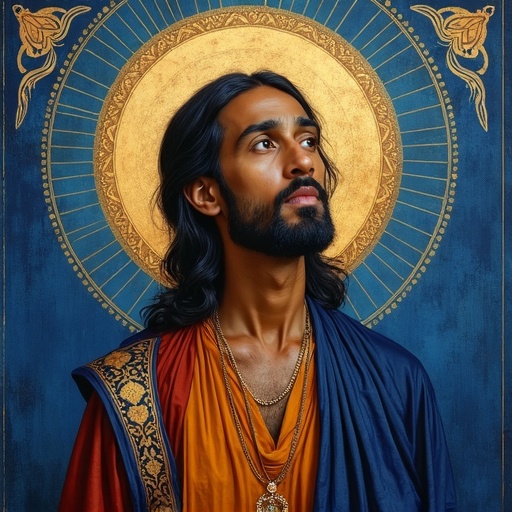
In this kirtan presentation, the spiritual practice of chanting the Hanuman Chalisa is explored through the extraordinary life story of Tulsidas (1532–1623), the Hindi poet-saint who composed this 40-verse hymn. The performance traces how Tulsidas moved from writing Sanskrit poetry to channeling the vernacular language of Awadhi, eventually meeting Rama in physical form through the grace of Hanuman—a mystical encounter that fulfilled his deepest spiritual longing and gave birth to one of Hindu devotionalism's most beloved texts. The Hanuman Chalisa itself is presented not as mere poetry but as a prayer born from direct devotional realization.
Who Was Tulsidas and Why Does His Story Matter?
The biography of Tulsidas begins with a remarkable birth story rooted in mystical symbolism. Born on August 13, 1497, near Chitrakoot in North India, Tulsidas (then named Rambola, "he who calls out to Ram") was said to have emerged from his mother's womb after an unusual 12-month gestation. Rather than crying as newborns typically do, the infant uttered the sacred syllable "Ram"—a sign that his life would be devoted entirely to the divine name. This opening detail establishes what became the defining characteristic of Tulsidas's entire existence: an unquenchable yearning for direct communion with Rama.
Years later, after receiving formal initiation from his spiritual guru, Rambola took the name Tulsidas (literally "servant of Tulsi," referring to the sacred basil plant). Yet the path of a poet-saint was not straightforward. Tulsidas's early spiritual practice was marked by passionate longing and artistic dedication, but also by profound frustration—a struggle between intellectual attainment and the heart's deepest desire.
What Role Did Language Play in Tulsidas's Spiritual Transformation?
A crucial turning point came when Tulsidas arrived in Varanasi, the sacred city of Shiva. Believing that Sanskrit—the classical language of scholars and scriptures—was the only fitting vehicle for sacred poetry, Tulsidas spent his days composing verses in Sanskrit. However, night after night, the pages would be mysteriously blown away, destroyed before they could take root. Week after week of this frustrating cycle continued until Tulsidas reached a breaking point of spiritual despair.
It was at this moment of surrender that Shiva and Parvati—the divine couple themselves—appeared to Tulsidas in a vision or revelation. They issued a profound instruction: stop writing in Sanskrit. Instead, compose in Awadhi, the vernacular language of the common people. This guidance was revolutionary. It shifted Tulsidas's entire understanding of spiritual poetry from being an intellectual exercise for the elite to becoming a living language that could touch the hearts of all people, regardless of their learning. Shiva and Parvati promised him that if he followed this path, his poetry would transform the world.
This instruction embodied a key principle of bhakti (devotional) spirituality: that divine truth is not the property of the learned few but belongs to all who hunger for it. By choosing the language of ordinary people, Tulsidas aligned his work with the actual spiritual needs of his community rather than abstract scholarly ideals.
How Did Tulsidas's Longing Lead Him to Hanuman?
Even with this new direction, Tulsidas's heart remained in a state of what the spiritual traditions call viraha—the painful separation from the beloved. "Day after day and night after night," the account tells us, "Tulsidas's heart was on fire, as he was set on the seemingly impossible dream of meeting Rama in His physical form, face to face." This was not a vague or abstract aspiration. It was a consuming obsession born from real devotional practice and real spiritual longing.
The resolution came through a spiritual intermediary. A mysterious figure—described as a spirit from the forest—revealed to Tulsidas a secret: only Hanuman, the great monkey devotee, possessed the power to grant his wish. Moreover, this same spirit offered extraordinary news: Hanuman himself was already present at the very kirtans and gatherings where Tulsidas sang the glories of Rama. But the monkey god was in disguise, appearing as a filthy leper among the crowd—invisible to all but those whose devotion was pure enough to see through the veil.
This element of the story contains profound spiritual teaching. It suggests that divine grace is often present in unexpected forms and among those we might overlook or dismiss. The leper, traditionally one of the most marginalized figures in society, becomes the vessel through which God's highest blessing arrives. Hanuman's disguise tests the sincerity of Tulsidas's devotion—would his longing for Rama be authentic and unconditional, or would it depend on external signs and recognition?
What Happened When Tulsidas Recognized Hanuman?
The next evening, as the kathan (sacred storytelling) concluded and the gathering dissolved, Tulsidas's eye fell upon the leper figure. In that moment, recognition dawned. Whether through intuition, vision, or the ripening of spiritual readiness, Tulsidas knew. He rushed forward, grabbed the leper's legs, and cried out: "I know who you are! Help me, oh noble Monkey!!!"
The response was immediate and unconditional. The account describes Hanuman's heart as being "like liquid compassion"—a metaphor for the boundless, fluid quality of divine mercy that cannot refuse a sincere call. Hanuman could not say no. The god agreed to arrange what seemed impossible: a meeting between Tulsidas and Rama himself.
This encounter reveals one of the central mysteries of Hindu devotional theology: the relationship between the devotee and the divine. In the Ramayana and later devotional texts, Hanuman represents perfect devotion—the one who desires nothing for himself except service to Rama. His willingness to intervene on Tulsidas's behalf illustrates a principle found across many wisdom traditions: that sincere longing, when it reaches a certain intensity and purity, activates compassionate response from higher dimensions of being.
How Did Rama Appear, and What Made the Meeting Transformative?
After some time had passed—the text leaves this duration vague, suggesting the inexpressible nature of spiritual waiting—Rama appeared to Tulsidas. But the divine did not manifest as an adult deity surrounded by splendor and power. Instead, Rama came as a small child. The simplicity and vulnerability of this form is theologically significant: the infinite reduces itself to the form most intimate and most capable of melting a devotee's heart.
The child Rama made a gentle request: he asked Tulsidas to apply sandalwood paste (chandan) as a tilak to his forehead. Sandalwood in Hindu ritual carries multiple meanings—it is cooling, purifying, sacred, and associated with the heart center. By asking Tulsidas to apply it, the child Rama was inviting the devotee into an act of service, the most fundamental expression of bhakti.
Yet Tulsidas did not immediately understand what was occurring. He did not recognize the child as the Lord himself. It was Hanuman, still present and guiding from the shadows, who offered a sign: a hint that this child was indeed Rama, the Supreme Lord. At that moment, the full weight of realization struck Tulsidas. The longing that had burned in his heart for years, the impossible dream he had pursued, was now standing before him in the form of a child asking for his service.
The account records that Tulsidas "became so entranced that he froze." This freezing, this moment of total absorption and overwhelmed devotion, is described in Sanskrit texts as samadhi—absorption into the divine. Time stopped. The separate sense of self dissolved in the presence of the infinite.
What happened next completed the circle of grace. Little Rama, seeing that Tulsidas had recognized him but could not move or speak, gently applied the sandalwood tilak first to his own forehead, then to Tulsidas's forehead. In that touch, the divine blessed the devotee. And then, in an instant, Rama disappeared. The vision ended. But something permanent had shifted. "Tulsidas's soul had found ultimate fulfillment."
What Is the Hanuman Chalisa, and Why Was It Composed After This Meeting?
The mystical meeting between Tulsidas and Rama was not the end of the story but the beginning of its fruit. Following this direct experience of the divine, Tulsidas went on to compose the epic Sri Ramacharitmanas ("The Ocean of the Story of Rama"), which became one of the most influential works of Hindi literature and Hindu devotional practice. Within this larger work, he also composed the Hanuman Chalisa (the "Forty Verses on Hanuman").
The Hanuman Chalisa is not an abstract hymn but a spontaneous overflow of gratitude and devotion directed toward Hanuman, the one whose compassion had made the impossible meeting possible. Each verse praises Hanuman's qualities, recounts his deeds, and invokes his blessings. The text transforms the monkey devotee from a character in an epic story into a living, accessible presence that the practitioner can address directly through chant and prayer.
What makes the Hanuman Chalisa extraordinary is that it was born not from intellectual study or literary ambition but from direct spiritual experience and the overflowing heart of a devotee who had touched the divine. This explains why the text carries such power in devotional practice: it is the record of what happens when longing meets grace, when the human heart opens completely to the divine, and when that opening is expressed through the language of ordinary people in their own vernacular tongue.
What Does This Story Teach About Devotion and Spiritual Practice?
The life of Tulsidas as presented through this kirtan illustrates several dimensions of bhakti (devotional) spirituality. First, it shows that sincere longing—the willingness to burn with desire for God, to let that desire consume your every waking moment—is not a spiritual obstacle but the very fuel of the path. Tulsidas's heart was "on fire" not because of psychological disturbance but because of genuine spiritual aspiration.
Second, the story demonstrates the principle of surrender and course correction. Tulsidas had to be redirected away from Sanskrit scholarship toward the vernacular language of Awadhi. This required him to release his attachment to a particular idea of how spiritual work "should" be done and to trust guidance that came from beyond his own understanding. Many spiritual paths emphasize this principle: the guru or divine instruction often asks us to abandon our cherished plans and preconceptions.
Third, the account illustrates the power of intermediary figures and guides. Hanuman appears in the story not as a separate savior but as the one whose devotion to Rama is so complete that he naturally and effortlessly becomes a bridge between the longing devotee and the divine object of love. This reflects the traditional understanding that spiritual guides and awakened beings function as mirrors and conduits of grace rather than as ultimate sources.
Finally, the meeting itself—the moment when the child Rama appears—reveals something essential about how the divine is said to work in Hindu theology. The infinite takes a finite form. The transcendent becomes intimate. The untouchable becomes a child asking for service. And in that moment of recognition and touch, the devotee is transformed utterly and permanently.
Where to go from here
To deepen engagement with the Hanuman Chalisa beyond this narrative context, consider learning the text itself in Sanskrit or Awadhi, either through singing or memorization. Many recordings and tutorials are available online. Reading translations paired with commentary can illuminate the theological and practical meanings of each verse. Exploring the Ramacharitmanas as a whole provides the larger epic context in which Hanuman's devotion unfolds. You might also investigate the historical Tulsidas through scholarly biographies to distinguish legend from documented fact, while honoring the spiritual truth that myths convey. Finally, if drawn to the devotional path itself, connecting with practitioners of bhakti through kirtan groups or spiritual communities can provide both guidance and the living transmission of these teachings through sound and presence.